
Classification by Function: Three Basic Types
1. Direction Control Valves
Direction control valves are used to control the on/off state and direction of hydraulic flow in a hydraulic system, thereby changing the movement direction of actuators. They mainly include:
-
Check valves
Also known as non-return valves, these valves allow fluid to flow in only one direction and prevent reverse flow. During installation, special attention must be paid to ensure that the flow direction of the medium is consistent with the arrow marked on the valve body. -
Pilot-operated check valves
Based on a check valve, a control oil port (K) is added. When the pilot oil circuit is activated, reverse flow is allowed. These valves are commonly used for hydraulic cylinder locking applications, such as crane outriggers. -
Directional control valves
These valves have two or more flow paths and more than two ports. By moving the valve spool, the connection state of the ports (e.g., P–A/B–T switching) is changed to achieve flow connection, shut-off, and reversal. According to the number of positions and ports, common types include two-position two-way, two-position four-way, three-position four-way, and three-position five-way valves.
2. Pressure Control Valves
Pressure control valves are used to control or regulate hydraulic system pressure or to trigger specific actions based on pressure changes. They mainly include:
-
Relief valves
A type of pressure control valve primarily used for pressure limiting, pressure stabilization, system unloading, and safety protection. When system pressure exceeds the set value, the relief valve opens and diverts excess flow back to the tank, maintaining constant system pressure. -
Pressure reducing valves
These valves reduce inlet pressure to a required outlet pressure and maintain stable outlet pressure using the energy of the fluid itself. Through throttling and feedback mechanisms, they provide stable low pressure and are especially suitable for control circuits and clamping systems. -
Sequence valves
In systems with two or more branch circuits, sequence valves control the operating order of actuators based on circuit pressure. According to control methods, they can be classified into internally piloted/internal drain, internally piloted/external drain, externally piloted/internal drain, and externally piloted/external drain types. -
Pressure switches
Devices that convert pressure signals into electrical signals. When system pressure reaches a preset value, an electrical signal is output to control other components.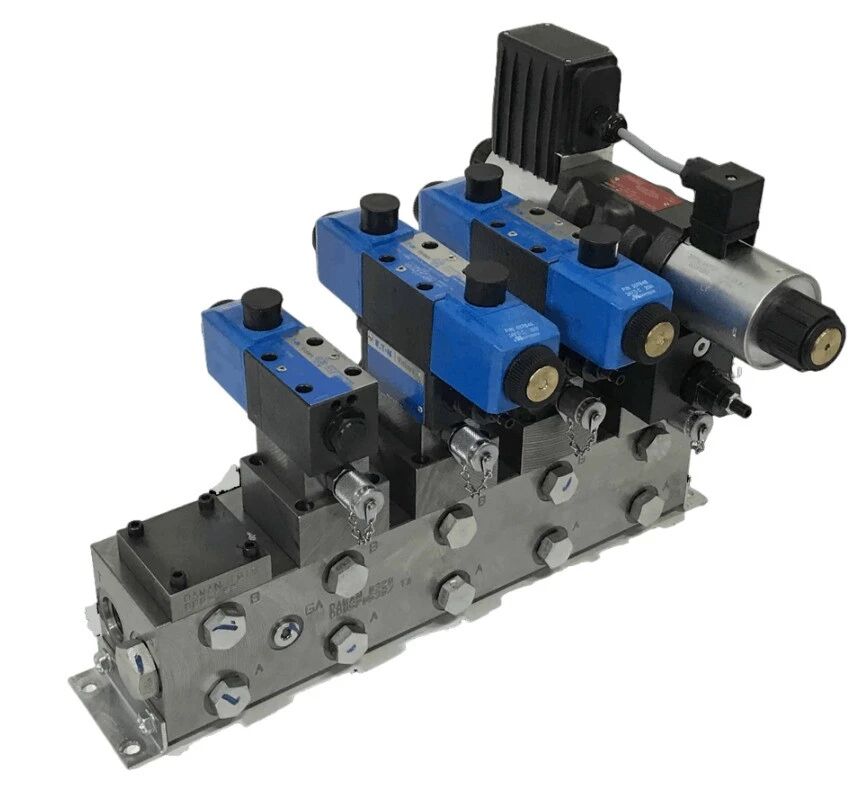
3. Flow Control Valves
Flow control valves regulate actuator speed by changing the flow area or flow path length of the fluid. They mainly include:
-
Throttle valves
These valves control flow by changing the throttling cross-section or throttling length. However, they do not have flow feedback compensation and therefore cannot compensate for speed instability caused by load variations. -
Flow control valves (speed control valves)
Composed of a pressure-compensated valve and a throttle valve connected in series, these are pressure-compensated throttle valves. They eliminate the influence of load changes on flow rate, maintaining stable flow. They are widely used in high-precision machine tool feed systems and synchronous circuits. -
Flow divider/combiner valves
Also known as synchronous valves, these valves combine the functions of flow dividing and combining. They ensure that two or more actuators receive equal or unequal flow rates to achieve synchronized motion.
Classification by Actuation Method: Diverse Power Sources
According to the actuation method, hydraulic valves can be classified as follows, which determines the power source and control method of valve operation:
-
Manual valves
Operated by manual force through levers, handwheels, pedals, or handles. They are simple to operate, reliable, and require no electrical power. -
Mechanical valves
Also known as limit or cam valves, these are actuated by stops, cams, springs, or hydraulic/pneumatic pressure. -
Electrically actuated valves
Controlled by electrical devices such as solenoids, servo motors, or stepper motors to move the valve spool. -
Hydraulically actuated valves
Use hydraulic pressure to actuate the valve spool and are suitable for large-flow applications.
Classification by Control Method: Different Levels of Precision
Based on control methods, hydraulic valves can be divided into traditional control valves and electro-hydraulic control valves, reflecting the integration of hydraulic and electronic technologies:
-
On–off or fixed-value control valves
Including conventional valves, cartridge valves, and sandwich (modular) valves. These valves usually operate in simple on/off states or at a fixed preset value. -
Electro-hydraulic control valves
Combining hydraulic and electronic technologies, these valves enable more precise and continuous control.-
Electro-hydraulic servo valves
These valves proportionally and continuously control flow direction, pressure, and flow rate based on input signals (electrical, mechanical, pneumatic) and feedback signals. They offer high precision and fast response. -
Electro-hydraulic proportional valves
Positioned between conventional control valves and servo valves, they proportionally control hydraulic parameters according to input signal magnitude. Their precision is lower than servo valves, but they offer simpler structure and partial servo performance. -
Electro-hydraulic digital valves
Use digital signals to directly control valve opening and closing, thereby regulating flow direction, pressure, and flow rate. They can be directly connected to computer systems.
-
Classification by Mounting and Connection Method: Flexible Configurations
According to mounting and connection methods, hydraulic valves can be classified as follows, which affects system integration and maintenance convenience:
-
Pipe-mounted (threaded) valves
The valve body is equipped with threaded ports and connected directly to pipelines. The structure is simple, but disassembly is inconvenient. -
Subplate-mounted valves
Valves are mounted on a dedicated subplate, with oil passages connected through drilled channels in the plate. They are easy to disassemble and maintain. -
Integrated mounting systems
Designed to achieve compact structures and simplified piping. These mainly include:-
Manifold block mounting
Multiple valves are mounted on a specially designed manifold block with internal oil passages. -
Sandwich (modular) valve mounting
Valves are stacked together and connected by bolts, reducing external piping.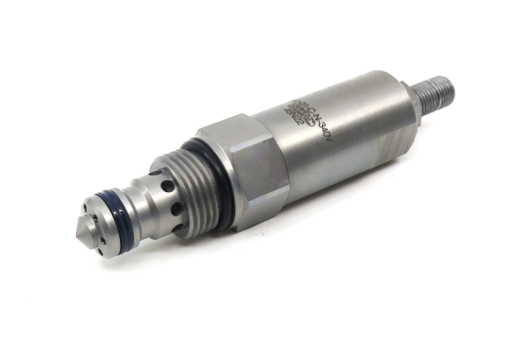
-
Cartridge valve mounting
Valves are inserted into dedicated valve blocks or covers. This structure is compact and offers large flow capacity (up to 1000 L/min), making it suitable for high-flow systems.
-
Classification by Structural Design: Internal Structural Differences
According to the structural form of the main valve element, hydraulic valves can be classified as:
-
Spool valves
The valve element is cylindrical or flat, and flow paths are controlled by sliding motion. These include cylindrical spool valves, rotary valves, and plate valves. -
Poppet valves
Control flow through the relative movement between the valve element and valve seat. They offer good sealing performance and high pressure resistance, including cone valves, ball valves, and nozzle–flapper valves. -
Jet valves
Operate based on fluid jet effects, such as jet-pipe valves.
Correct selection and application of hydraulic valves are critical to ensuring efficient and reliable hydraulic system operation. With the deep integration of electronic and hydraulic technologies, the development of intelligent hydraulic valves—such as proportional valves, servo valves, and digital valves—is driving hydraulic systems toward higher precision, faster response, and greater intelligence.