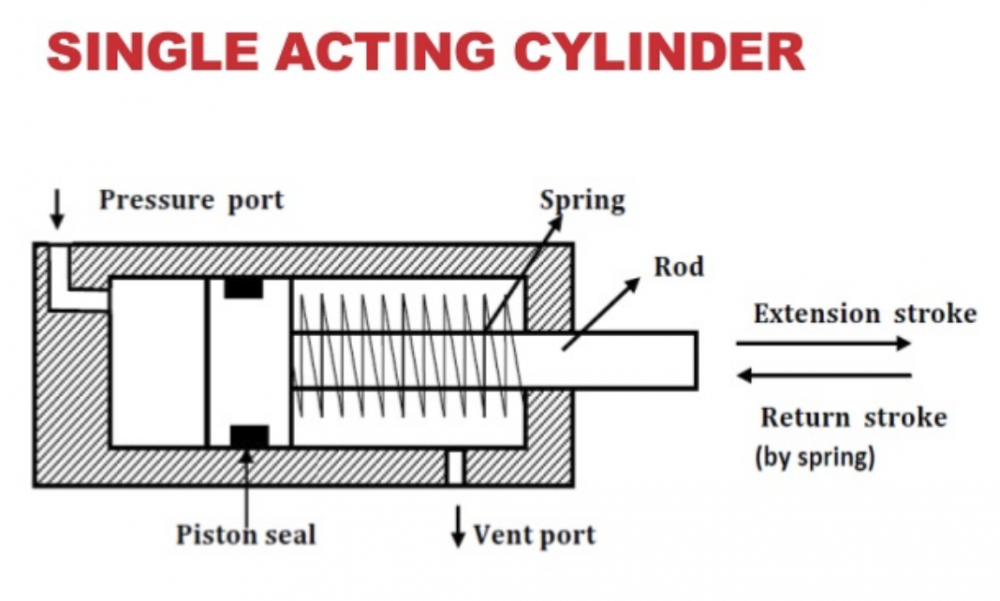
Components of a Single Acting Hydraulic Cylinder:
Cylinder Barrel: The outer cylindrical housing that houses the piston and other internal components.
Piston: The movable component that divides the cylinder barrel into two chambers.
Rod: Extends from the piston and provides the linear motion when hydraulic pressure is applied.
Seals: Ensure proper sealing between the piston, cylinder barrel, and rod to prevent fluid leakage.
Operating Principles:
Hydraulic Fluid: A pressurized hydraulic fluid (usually oil) is supplied to the cylinder through an inlet port, creating a force on the piston.
Single Acting Configuration: In a single-acting cylinder, hydraulic pressure is applied only on one side of the piston, typically referred to as the "cap end."
Cap End Chamber: When hydraulic pressure enters the cap end chamber, it pushes the piston and rod outward, generating linear motion.
Return Stroke: To retract the rod, an external force (gravity, spring, or load) is applied to the rod, pushing the hydraulic fluid back into the reservoir or returning it to the hydraulic power unit.
Common Applications:
Lifting Mechanisms: Single-acting cylinders are commonly used in lifting applications where the load needs to be raised and lowered in a controlled manner, such as in dump trucks, forklifts, and material handling equipment.
Clamping Systems: Single-acting cylinders can provide clamping or holding force in applications like welding fixtures, assembly stations, or presses.
Ejector Systems: Single-acting cylinders are used to provide a force for ejecting or releasing objects in various manufacturing processes, such as injection molding machines or stamping presses.
Advantages and Considerations:
Simplicity: Single-acting cylinders have a straightforward design and require fewer components than their double-acting counterparts, making them easier to maintain and repair.
Directional Control: Single-acting cylinders can only provide force in one direction, requiring external forces or mechanisms to retract the rod.
Efficiency: As hydraulic pressure is applied only on one side of the piston, single-acting cylinders are generally more energy-efficient compared to double-acting cylinders.
Conclusion:
Understanding the operation principles and applications of single-acting hydraulic cylinders is essential for optimizing their performance and selecting the right cylinder for specific applications. By comprehending the components, operating principles, and advantages of single-acting cylinders, you can make informed decisions and ensure efficient operation in hydraulic systems.
For further details regarding hydraulic products, feel free to explore our offerings in Hydraulic Hose and Hydraulic Fittings.