Construction and Components:
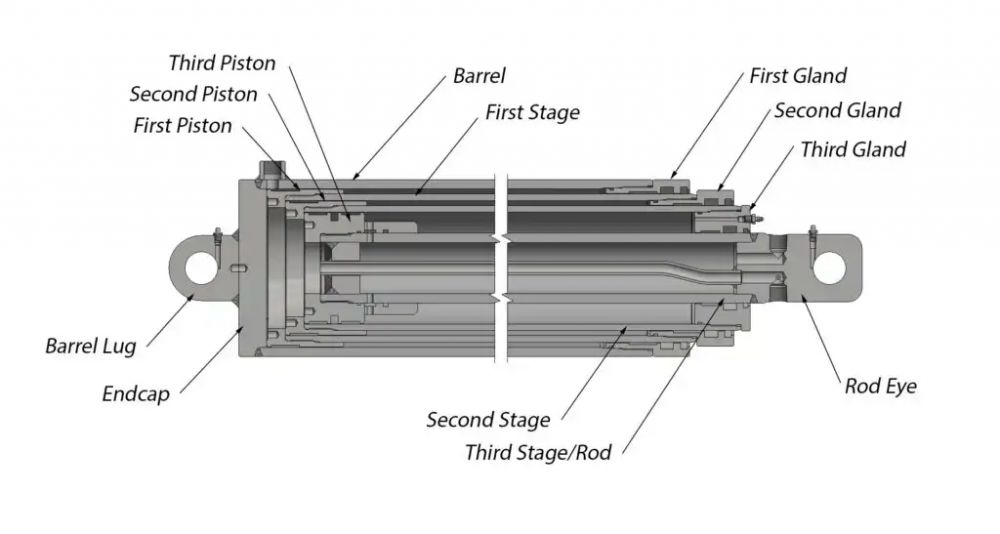
Barrel Sections: Telescopic cylinders consist of multiple barrel sections that nest inside each other. These sections are typically made of steel or aluminum and are designed to slide within one another.
Piston Rods: Each barrel section is equipped with a piston rod that connects to the piston head. These rods provide stability and transmit force from the hydraulic fluid to the piston.
Seals: Sealing elements are crucial in telescopic cylinders to prevent fluid leakage between the barrel sections.
Operating Mechanism:
Hydraulic Fluid Supply: Pressurized hydraulic fluid, typically oil, is supplied to the cylinder through an inlet port.
Extension Stroke: When hydraulic pressure is applied to the cylinder, it acts on the piston, causing the barrel sections to extend progressively, one after another. This allows the cylinder to achieve a longer stroke length compared to its retracted length.
Retraction Stroke: To retract the cylinder, hydraulic pressure is released, and external forces or gravity help collapse the barrel sections back into their nested position.
Advantages and Considerations:
Extended Stroke Length: Telescopic cylinders offer an extended stroke length compared to their compact retracted length, making them ideal for applications with limited space.
Multi-Stage Extension: The nested design of telescopic cylinders allows them to provide multiple stages of extension, enabling precise control over various positions and applications.
Increased Stability: Telescopic cylinders provide enhanced stability due to the multiple piston rods and the interlocking design of the barrel sections.
Maintenance Considerations: Telescopic cylinders may require additional maintenance due to the increased number of seals and moving parts. Regular inspection and proper lubrication are essential to ensure optimal performance.
Common Applications:
Dump Trucks: Telescopic cylinders are commonly used in dump trucks to raise and lower the truck bed for loading and unloading materials.
Mobile Cranes: Telescopic cylinders provide the required reach and lifting capacity in mobile crane applications, allowing for efficient and flexible lifting operations.
Material Handling Equipment: Telescopic cylinders are utilized in various material handling equipment, such as forklifts, scissor lifts, and aerial platforms, to achieve extended lifting heights.
Conclusion:
Understanding the operation and advantages of telescopic hydraulic cylinder is crucial for selecting the appropriate cylinder for specific applications. By comprehending the construction, operating mechanism, and common applications of telescopic cylinders, you can make informed decisions and optimize their performance in hydraulic systems.
If you would like additional information about our hydraulic products, please visit our pages on Hydraulic Hose and Hydraulic Fittings.