
Hydraulic hoses are key components in hydraulic systems and are used for hydraulic power transmission. Depending on their structure and performance characteristics, commonly used hydraulic hoses can be classified into wire-braided hoses and wire-spiral hoses, each offering different pressure ratings, flexibility, and durability to meet various operating environments and pressure conditions.
In addition, the quality and reliability of hydraulic hoses are not only closely related to their internal structural design, but also to the standards implemented during manufacturing. These standards impose strict requirements on materials, dimensions, and pressure performance, ensuring that hydraulic hoses operate safely and reliably in different hydraulic systems.
This article provides a detailed introduction to the structure, classification, and characteristics of hydraulic hoses, helping readers gain a deeper understanding of hydraulic hoses.
1. Structure of Hydraulic Hoses
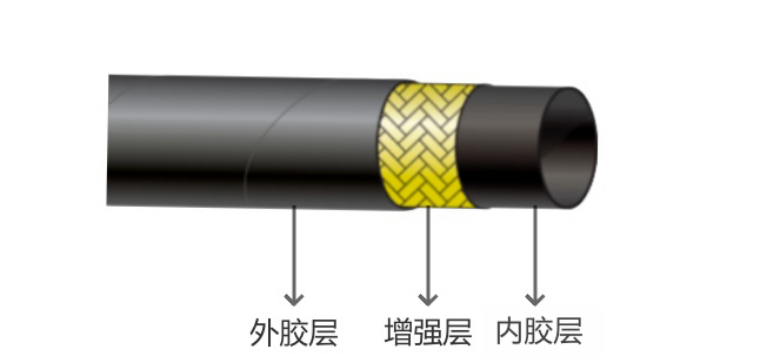
Hydraulic hoses generally consist of three main layers: inner tube, reinforcement layer, and outer cover. Each layer plays a critical role in the overall performance of the hose.
1.1 Inner Tube
The inner tube is the core component of the hydraulic hose and is primarily responsible for conveying hydraulic oil or other fluids. It must have excellent oil resistance, corrosion resistance, and high-temperature resistance to prevent the fluid medium from corroding the steel-wire reinforcement layer.
The inner tube is usually made of specially formulated rubber materials to ensure fluid sealing performance and prevent leakage.
1.2 Reinforcement Layer
The reinforcement layer serves as the structural backbone of the hydraulic hose and is responsible for withstanding the high pressure within the hydraulic system. It is typically made of steel wire, polyester fiber, or other high-strength materials that are braided or spirally wound.
The main function of the reinforcement layer is to provide sufficient strength and elasticity, ensuring hose stability under high-pressure and high-stress conditions. Depending on the reinforcement design, hydraulic hoses can be divided into wire-braided structures and wire-spiral structures, which differ in pressure capacity and applicable pressure ranges.
1.3 Outer Cover
The outer cover protects the hose from external damage such as abrasion, ultraviolet radiation, chemical exposure, and mechanical impact. It is usually made of wear-resistant, UV-resistant, and heat-resistant rubber materials.
The outer cover not only extends the service life of the hose but also ensures stable performance in harsh operating environments.
2. Classification of Hydraulic Hoses
2.1 Classification by Structure
According to the structure of the reinforcement layer, hydraulic hoses are commonly classified into wire-braided hydraulic hoses and wire-spiral hydraulic hoses, which are suitable for medium-to-low-pressure and high-pressure hydraulic systems, respectively.
2.1.1 Wire-Braided Hydraulic Hoses
This type of hydraulic hose uses one or more layers of braided steel wire as the reinforcement layer. It offers good flexibility and is suitable for medium- and low-pressure applications.
Wire-braided hoses are widely used in hydraulic systems with relatively lower pressure requirements, providing reliable pressure resistance and tensile strength.
2.1.2 Wire-Spiral Hydraulic Hoses
Wire-spiral hydraulic hoses use multiple layers of steel wire wound in a spiral pattern as the reinforcement layer. This structure provides higher pressure resistance and superior shock resistance, making these hoses suitable for high-pressure hydraulic systems.
Due to their robust structure, wire-spiral hoses demonstrate excellent stability under high-pressure conditions and external mechanical stress.
2.2 Classification by Number of Reinforcement Layers
Hydraulic hoses can also be classified according to the number of reinforcement layers, which determines their strength and suitability for different pressure environments.
-
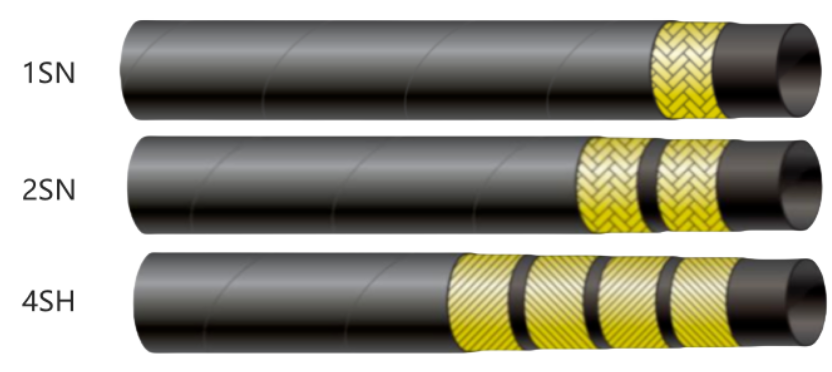
1SN: Single-wire reinforcement hose, suitable for low-pressure hydraulic systems
-
2SN: Double-wire reinforcement hose, capable of withstanding medium pressure and widely used in medium-sized machinery and industrial equipment
-
4SP and 4SH: Four-wire reinforcement hoses, designed for high-pressure hydraulic systems and commonly used in heavy machinery and high-pressure hydraulic equipment
Selecting a hydraulic hose with an appropriate number of reinforcement layers is essential to ensure system stability and operational safety.
2.3 Applicable Standards
Hydraulic hose standards vary according to different countries and international organizations. The main standards include:
-
GB (China National Standards)
-
ISO (International Organization for Standardization)
-
EN (European Standards)
-
SAE (Society of Automotive Engineers, USA)